Disclosure: This article may contain affiliate links. If you buy through these links, we may earn a commission at no extra cost to you. Our recommendations are based on editorial criteria, not commission rates.
Millions of people take statins to lower LDL cholesterol and reduce heart attack and stroke risk. Statins are among the most evidence-backed drugs in cardiology. They also lower CoQ10 (coenzyme Q10) levels in blood and muscle — because CoQ10 and cholesterol share parts of the same biosynthetic pathway (mevalonate pathway).
Some statin users develop muscle pain, weakness, or cramping (statin-associated muscle symptoms, SAMS). Whether CoQ10 supplements reliably prevent or fix those symptoms is debated: several trials show benefit; others show none. Major cardiology societies do not routinely recommend CoQ10 for all statin users — but many clinicians discuss it case-by-case when muscle symptoms appear.
Never stop a statin without your prescriber. This article is education, not a substitute for cardiology care.
Quick answer
If you take a statin without muscle symptoms, routine CoQ10 is optional — not guideline-mandated. If you have new muscle pain, cramping, or weakness after starting or increasing a statin, report it promptly; your clinician may adjust the statin, check labs, and consider CoQ10 (often 100–200 mg/day ubiquinol or 200–400 mg ubiquinone) as an adjunct while evaluating SAMS. CoQ10 does not replace statin therapy for LDL or event prevention.
Who this is for
Adults on atorvastatin, rosuvastatin, simvastatin, or other statins who heard CoQ10 prevents side effects — or who already have muscle symptoms and want evidence context for a prescriber conversation.
Who should be careful
Discuss CoQ10 with your cardiologist or pharmacist if you:
- Take warfarin (CoQ10 may affect INR)
- Use chemotherapy or have heart failure on complex regimens
- Have very low blood pressure
- Plan to stop statin due to pain without medical taper/switch plan
Muscle pain with dark urine may signal rhabdomyolysis — emergency care, not supplement trial.
Why statins affect CoQ10
Statins inhibit HMG-CoA reductase, slowing cholesterol production and also CoQ10 synthesis. Muscle cells depend on CoQ10 for mitochondrial energy — a plausible link to SAMS, though not the only explanation (vitamin D, genetics, drug interactions also matter).
| Statin | Relative potency | SAMS risk notes |
|---|---|---|
| Rosuvastatin, atorvastatin | High potency | Common prescriptions |
| Simvastatin | Higher interaction/muscle risk at high dose | Drug interaction watchlist |
| Pravastatin, fluvastatin | Lower potency | Sometimes tolerated better |
See our full CoQ10 for heart health guide for forms and general cardiovascular evidence.
What research shows on CoQ10 for statin muscle symptoms
Supportive studies:
- Meta-analyses of some RCTs report reduced muscle pain scores when CoQ10 added to statin therapy
- Mechanistic plausibility from CoQ10 depletion
Null or mixed studies:
- Other trials show no significant difference vs placebo for SAMS
- Guidelines (e.g., some cardiology groups) cite insufficient evidence for routine recommendation
Clinical reality: Low risk and moderate cost lead many clinicians to trial CoQ10 when SAMS is suspected and statin is still indicated for cardiovascular risk.
Ubiquinol vs ubiquinone with statins
| Form | Notes |
|---|---|
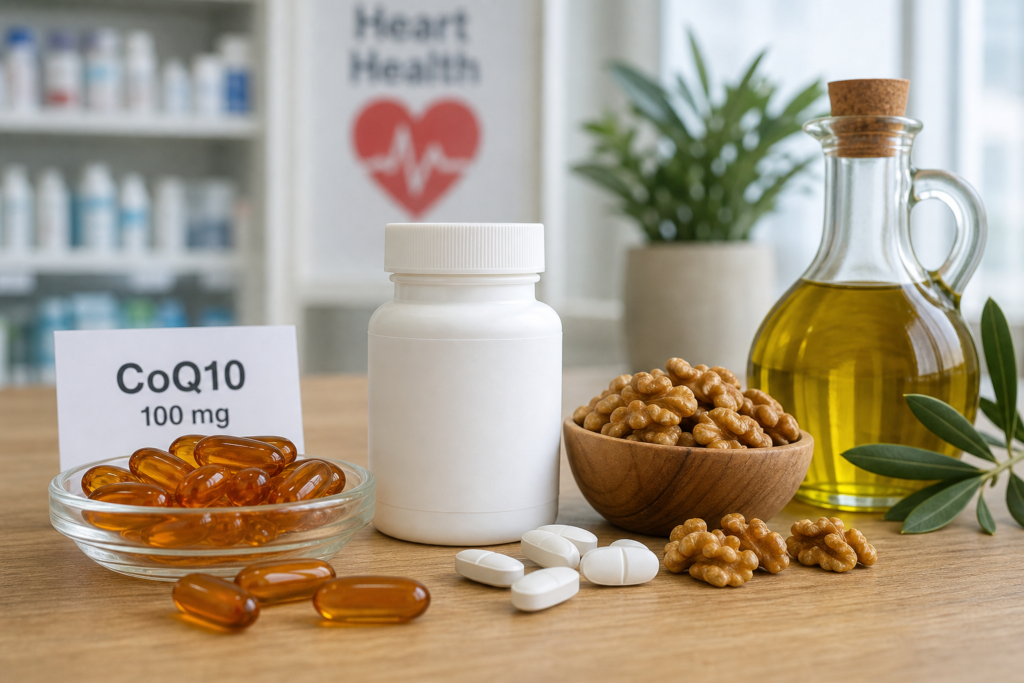
| Ubiquinol | Reduced form; better absorption in older adults; often 100–200 mg/day |
| Ubiquinone | Oxidized form; cheaper; often 200–400 mg/day equivalent |
Take with fat-containing meal for absorption. Allow 4–8 weeks to judge muscle symptom change.
What to do if you have muscle pain on a statin
- Contact prescriber — do not silently stop.
- Review drug interactions (gemfibrozil, azole antifungals, macrolides, etc.).
- Check vitamin D, thyroid, CK if indicated.
- Consider dose reduction, alternate statin, or alternate-day dosing — prescriber decision.
- Trial CoQ10 if still indicated on statin and symptoms persist.
- Report dark urine, severe weakness, fever.
CoQ10 is adjunctive — statin modification is primary management.
Why doctors do not universally recommend CoQ10
- Event reduction comes from LDL lowering, not CoQ10 repletion
- Trial heterogeneity and modest effect sizes
- Cost and pill burden
- Not all muscle pain is statin-caused (polymyalgia, hypothyroidism, activity)
That does not mean supplementation is wrong for symptomatic individuals — it means personalized decisions.
Interactions and safety
CoQ10 is generally well tolerated (GI upset, insomnia rare). Watch:
- Warfarin INR shifts
- Theoretical overlap with blood pressure lowering (BP guide)
Use supplement safety checklist.
Frequently Asked Questions
Should everyone on statins take CoQ10?
Why don't doctors recommend CoQ10 with statins?
How long before muscle pain improves?
Can CoQ10 replace my statin?
Does CoQ10 affect cholesterol labs?
Best CoQ10 with atorvastatin?
Can I take CoQ10 with rosuvastatin?
Is muscle pain always the statin?
Bottom line
Statins save lives through LDL reduction but can lower CoQ10 and cause muscle symptoms in some users. CoQ10 supplementation is a reasonable, low-risk trial when SAMS is suspected and statins remain necessary — not a mandatory add-on for everyone. Work with your prescriber on statin adjustments first; use CoQ10 as support, not rebellion against prescribed therapy.
Related Articles
- CoQ10 for Heart Health: Benefits, Forms, and the Statin Connection
- Omega-3 Fish Oil: Benefits, Dosage, and How to Choose
- Psyllium Husk for Cholesterol
- How to Support Healthy Blood Pressure Naturally
- Supplement Side Effects: A Simple Safety Checklist
Sources
- JACC / cardiology reviews on statin-associated muscle symptoms — https://pubmed.ncbi.nlm.nih.gov/
- Meta-analyses: CoQ10 for statin myalgia — https://pubmed.ncbi.nlm.nih.gov/
- American Heart Association: Cholesterol medications — https://www.heart.org/en/health-topics/cholesterol
- NIH MedlinePlus: Coenzyme Q10 — https://medlineplus.gov/druginfo/natural/938.html
- FDA: Statin safety information — https://www.fda.gov/