Disclosure: This article may contain affiliate links. If you buy through these links, we may earn a commission at no extra cost to you. Our recommendations are based on editorial criteria, not commission rates.
Probiotics and prebiotics are both sold for gut health, often side by side, and sometimes in the same product. But they are fundamentally different things, they work through different mechanisms, and the right choice between them — or whether to use either at all — depends on what you are actually trying to improve.
The short answer: for most healthy adults with a low-fiber diet, prebiotic foods are the better first move. For specific digestive concerns, post-antibiotic recovery, or situations where a clinician recommends a targeted strain, a probiotic may be the more appropriate tool.
At a Glance: Probiotics vs Prebiotics
| Feature | Probiotics | Prebiotics |
|---|---|---|
| What are they? | Live microorganisms (good bacteria) | Non-digestible fibers (food for bacteria) |
| Primary Source | Yogurt, kefir, targeted supplements | Garlic, onions, asparagus, chicory root |
| Main Function | Adds new bacteria to the gut | Feeds existing beneficial bacteria |
| Who needs it most? | Post-antibiotics, specific IBS types | Almost everyone (general gut health) |
The clear definitions
What is a probiotic?
The World Health Organization defines probiotics as "live microorganisms that, when administered in adequate amounts, confer a health benefit on the host." These are typically bacteria (most often from the Lactobacillus or Bifidobacterium genera) or yeasts (most often Saccharomyces boulardii).
The key phrase is adequate amounts. The NIH Office of Dietary Supplements explicitly notes that not every product labeled as a probiotic has demonstrated health benefits. A label that says "50 billion CFU" does not automatically make a product effective for your specific situation, because:
- Strain specificity matters: Benefits shown for Lactobacillus rhamnosus GG do not necessarily apply to other Lactobacillus strains, even within the same species.
- Survival through the gut: Many probiotic bacteria die in stomach acid before reaching the large intestine. Enteric-coated or specifically survivable strains may have an advantage, but this varies by product.
- Colony forming units (CFU) at time of manufacture vs. time of consumption: CFU counts decline over time, especially in unrefrigerated products.
What is a prebiotic?
Prebiotics are compounds — typically non-digestible fibers or complex carbohydrates — that are selectively fermented by gut microorganisms in ways that confer a health benefit. They do not add new organisms to the gut. They selectively feed organisms that are already there, particularly beneficial species like Bifidobacterium and Lactobacillus.
The most studied prebiotics include. For a focused comparison of psyllium vs inulin as supplements — including dosing, IBS tolerability, and when to use each — see fiber supplements for appetite:
- Inulin (from chicory root, garlic, onions, asparagus)
- Fructooligosaccharides (FOS) (similar to inulin, often found in bananas, garlic, onions)
- Galactooligosaccharides (GOS) (found in human breast milk and some legumes)
- Resistant starch (found in cooled cooked potatoes, green bananas, legumes)
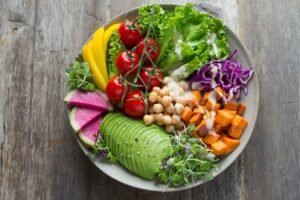
Foods naturally rich in prebiotic compounds:
- Garlic and onions
- Leeks and asparagus
- Chicory root (the basis for many prebiotic supplements)
- Dandelion greens
- Jerusalem artichoke
- Underripe bananas
- Oats and barley
- Legumes and lentils
If your diet regularly includes these foods, you are already feeding beneficial gut bacteria without supplementation.
Why most people should try prebiotics first
The gut microbiome is shaped primarily by what you eat — not by what you supplement. Decades of research have established that dietary fiber diversity is one of the strongest predictors of gut microbiome diversity, which is itself associated with better metabolic health, immune function, and reduced inflammation.
If your current diet is low in vegetables, legumes, whole grains, and fermented foods, the single most impactful thing you can do for your gut microbiome is add these foods. A high-quality probiotic supplement will deliver billions of live bacteria to your gut — but if those bacteria have nothing to eat when they arrive, their colonization will be transient.
Prebiotics from food also tend to:
- Be significantly cheaper than probiotic supplements
- Provide fiber, vitamins, minerals, and phytonutrients alongside their prebiotic effect
- Cause no concern about strain mismatching or survivability through the GI tract
- Work with the organisms already resident in your microbiome rather than introducing external ones
The practical first step is not purchasing a probiotic. It is honestly answering: "How many different plant foods do I eat per week, and do I eat any fermented foods regularly?"
When a probiotic may actually make sense
Probiotic supplements are not useless. There are evidence-supported use cases:
Post-antibiotic digestive recovery
Antibiotics kill both harmful and beneficial bacteria. Several Cochrane reviews and systematic analyses have found that specific probiotic strains — particularly Lactobacillus rhamnosus GG and Saccharomyces boulardii — meaningfully reduce the incidence and duration of antibiotic-associated diarrhea when taken during and after a course of antibiotics.
IBS with specific strain evidence
Several strains have been studied for irritable bowel syndrome. Evidence is most consistent for:
- Bifidobacterium infantis 35624 (Align) — studied for IBS symptom relief
- Lactobacillus plantarum 299v — studied for abdominal pain and bloating in IBS
- VSL#3 (a proprietary multi-strain blend) — studied for IBS and inflammatory bowel conditions
Note that IBS varies significantly by subtype (IBS-C, IBS-D, IBS-M), and no single probiotic works for all presentations.
Clinician-recommended use for a defined reason
If your gastroenterologist, physician, or registered dietitian recommends a specific strain for a specific condition, that recommendation is more credible than general wellness marketing. Ask them to name the genus, species, and ideally the strain, and the dose and duration they recommend.
Probiotic label literacy: what the numbers actually mean
Most probiotic labels include:
- Genus, species, and ideally strain: e.g., Lactobacillus (genus) rhamnosus (species) GG (strain). Products that list only genus and species without strain designation make it harder to match to published research.
- CFU count: 1–100 billion CFU is common. Higher is not always better. The clinically studied doses vary by strain and condition, typically ranging from 1–20 billion CFU.
- Expiration date or "viable through" date: CFUs decline over time. The count at manufacture may be 50 billion, but what reaches your gut may be substantially less, especially if storage conditions (temperature, humidity) have not been ideal.
- Storage instructions: Refrigerated probiotics are not automatically superior to shelf-stable ones — some strains are specifically engineered to survive without refrigeration. But refrigerated products that have been mishandled lose viability.
- Multi-strain vs. single-strain: More strains are not automatically better. A well-studied single-strain product at an appropriate dose may outperform a complex multi-strain blend where each strain is present at a dose too low to matter.
The synbiotic approach: combining prebiotics and probiotics
A synbiotic product combines a probiotic with a prebiotic designed to support that probiotic's colonization. The concept makes sense: you deliver beneficial bacteria alongside their preferred food source.
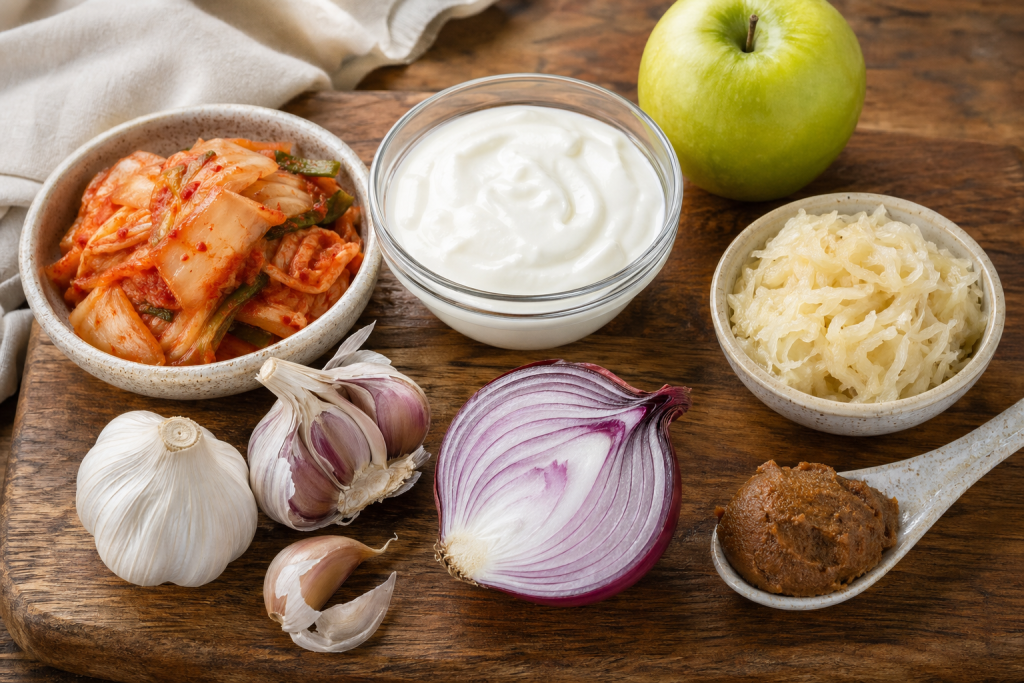
The evidence for synbiotics is promising but still emerging. Products marketed as synbiotics vary widely in quality. If you want to try this approach, the more practical version is simply to eat prebiotic foods alongside probiotic-containing foods (yogurt with berries, kimchi with a meal that includes garlic and onions) rather than buying an expensive combined supplement.
Fermented foods vs. probiotic supplements
Fermented foods — live-culture yogurt, kefir, sauerkraut, kimchi, miso, tempeh, and kombucha — are not interchangeable with probiotic supplements, but they are not inferior either.
Fermented foods provide:
- Live microorganisms (though counts and strains vary widely by product and brand)
- Metabolites produced during fermentation that may benefit the gut independently
- Vitamins (especially B vitamins and K2 in some fermented foods)
- Protein (in yogurt, kefir, tempeh)
- Bioactive compounds that have not yet been isolated into supplements
A 2021 study published in Cell found that a high-fermented-food diet increased gut microbiome diversity and reduced inflammatory markers significantly more than a high-fiber diet alone over a 10-week intervention. This was in healthy adults, and the fiber group showed different benefits — but it reinforced the independent value of fermented foods.
Who should be careful with probiotic supplements
Most healthy adults tolerate probiotics without problems. However, speak with your healthcare provider before using probiotic supplements if you:
- Are immunocompromised (on immunosuppressants, chemotherapy, or with conditions like HIV)
- Are critically ill or in an intensive care setting
- Have a central venous catheter
- Have short bowel syndrome
- Are pregnant — not that probiotics are categorically unsafe in pregnancy, but you should use evidence-backed strains at appropriate doses with medical guidance
- Are buying probiotics for an infant or child — consult their pediatrician
Reports of probiotic-related infections (sepsis, fungemia) are rare but real, and occur almost exclusively in immunocompromised individuals or people with significant gut barrier compromise.
How to track whether a probiotic is working
Without tracking, it is easy to take a probiotic for months without knowing whether it is doing anything. Keep a simple log:
- Your specific target symptom or goal: Not "gut health" but something measurable — frequency of bowel movements, bloating rating after meals, days of loose stool per week, or a specific IBS symptom.
- The product, strain, and dose.
- Start date and baseline measure.
- 4-week check-in: Has your target symptom changed? Be honest. If nothing has changed after 4–6 weeks of consistent use, the probiotic is unlikely to be the right tool for that symptom.
If you are taking a probiotic for general wellness with no specific target, reassess whether the cost is justified after 6–8 weeks.
Digestive enzymes: a different category entirely
Digestive enzymes — amylase, protease, lipase, lactase, and others — are not probiotics and not prebiotics. They help break down specific macronutrients. They are relevant for conditions like exocrine pancreatic insufficiency (insufficient enzyme production), lactose intolerance (lactase deficiency), or as a targeted intervention for specific malabsorption issues.
Broad-spectrum enzyme blends marketed for "digestive support" in otherwise healthy people have weaker evidence. If you have specific malabsorption symptoms, discuss enzyme testing and targeted supplementation with your gastroenterologist rather than self-prescribing a blend.
Frequently Asked Questions
What is the main difference between probiotics and prebiotics?
Which should I try first: probiotics or prebiotics?
Can I take probiotics and prebiotics together?
Do probiotics actually survive in the stomach?
How do I know if my probiotic is working?
Are refrigerated probiotics better than shelf-stable ones?
Is yogurt as good as a probiotic supplement?
What is CFU and how much do I need?
Can probiotics cause side effects?
Do prebiotics cause bloating?
Bottom line
Probiotics add specific live microorganisms; prebiotics feed beneficial bacteria that are already present in your gut. For most healthy adults, improving prebiotic intake through food comes first — it is cheaper, broader in benefit, and addresses the root cause of microbiome diversity issues. Probiotic supplements have evidence-supported use cases, but the strain, dose, and indication matter far more than the CFU count or the price. When in doubt about which to try and why, ask your provider to be specific about genus, species, strain, dose, and duration rather than accepting a vague recommendation to "take a probiotic."
Related Articles
- Fiber Supplements for Appetite: Psyllium vs Inulin
- How to Improve Gut Health Naturally: Diet, Habits, and Supplements
Sources
- NIH Office of Dietary Supplements: Probiotics — https://ods.od.nih.gov/factsheets/Probiotics-HealthProfessional/
- WHO: Health and nutritional properties of probiotics in food — https://www.who.int/foodsafety/publications/fs_management/en/probiotics.pdf
- Cell 2021: Gut-microbiota-targeted diets modulate human immune status — https://pubmed.ncbi.nlm.nih.gov/34256014/
- Cochrane Review: Probiotics for antibiotic-associated diarrhea — https://pubmed.ncbi.nlm.nih.gov/23152445/
- MedlinePlus: Dietary Fiber — https://medlineplus.gov/dietaryfiber.html
- Gut Microbes 2017: Inulin and gut microbiota — https://pubmed.ncbi.nlm.nih.gov/27435027/