Disclosure: This article may contain affiliate links. If you buy through these links, we may earn a commission at no extra cost to you. Our recommendations are based on editorial criteria, not commission rates.
————————- | ——————————- | ——————————————————————– |
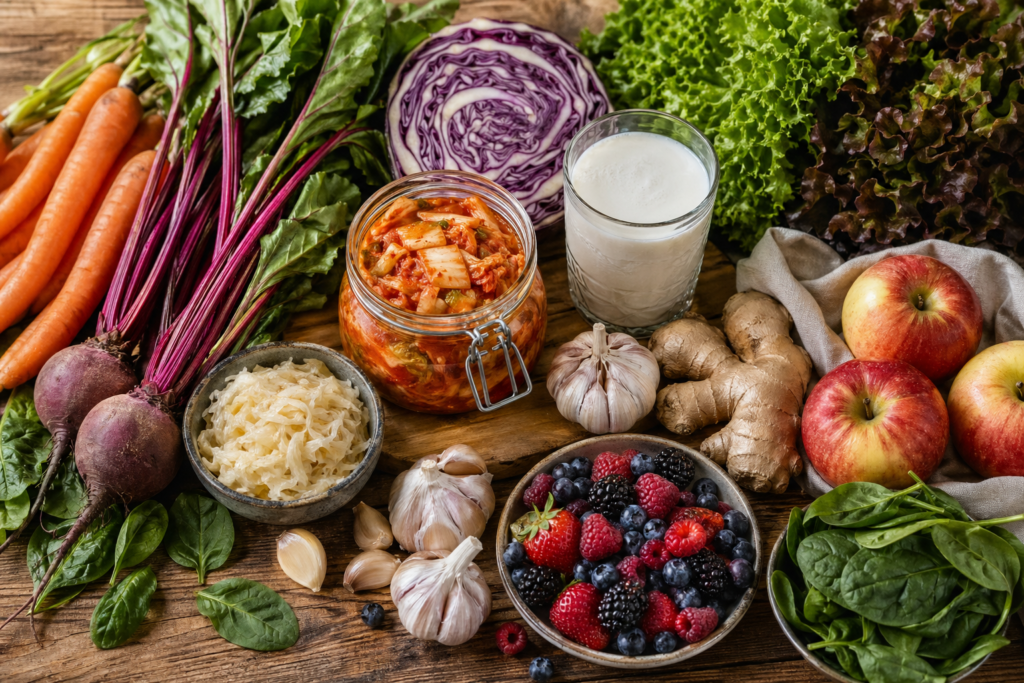
| Plain yogurt (live cultures) | Lactobacillus, Bifidobacterium | Choose unsweetened; live cultures label required |
|---|---|---|
| Kefir | 30+ bacterial and yeast strains | Greater diversity than yogurt; 25–30 billion CFU typical |
| Sauerkraut (unpasteurized) | Lactobacillus plantarum, others | Must be refrigerated, not canned/shelf-stable |
| Kimchi | Lactobacillus kimchii, others | Rich in prebiotic fiber + live bacteria |
| Miso | Aspergillus, Lactobacillus | Also a source of prebiotic fiber from soybeans |
| Kombucha | Yeast and bacteria SCOBY | Lower bacterial content than other fermented foods; variable quality |
| Tempeh | Rhizopus mold + fermentation | High protein, prebiotic fiber, fermentation benefits |
Start with 1–2 servings per day of fermented foods and increase tolerance gradually. People with SIBO (small intestinal bacterial overgrowth) may initially react to fermented foods and should introduce them carefully.
Step 3: Reduce ultra-processed food and added sugar
Ultra-processed foods — industrially manufactured products with multiple additives, emulsifiers, and artificial ingredients — are associated with reduced microbiome diversity and increased inflammatory microbiome signatures in multiple observational and intervention studies.
Emulsifiers in particular (polysorbate 80, carboxymethylcellulose) commonly found in processed foods have been shown in animal studies to disrupt the mucus layer protecting gut epithelial cells and alter microbiome composition. Human data is still emerging but consistent with the animal findings.
Added sugar — particularly fructose — preferentially feeds pathogenic bacterial species like Clostridioides difficile and certain Proteobacteria over beneficial Bifidobacterium and Lactobacillus species.
Practical reductions with the most gut-health impact:
- Reduce sugar-sweetened beverages (the most consistent dietary enemy of microbiome diversity in the research)
- Replace ultra-processed snack foods with whole food alternatives
- Minimize artificial sweeteners (particularly saccharin and sucralose — several trials show they disrupt microbiome composition and glucose metabolism)
Step 4: Address lifestyle factors
Sleep: A 2019 study found that even two nights of poor sleep reduced Bifidobacterium diversity and increased inflammatory microbiome markers. The gut-brain axis operates bidirectionally — poor sleep disrupts the gut, and a disrupted gut worsens sleep quality. Prioritizing 7–9 hours of sleep is a genuine gut health intervention.
Stress management: Chronic psychological stress suppresses Lactobacillus populations and increases intestinal permeability through corticotropin-releasing hormone (CRH) signaling in gut cells. Mindfulness practices, exercise, and social connection all reduce cortisol and have documented positive effects on microbiome markers in clinical research.
Exercise: Multiple trials have found that regular aerobic exercise increases fecal butyrate production and microbial diversity, independent of diet. A 2018 study published in Gut randomized 18 lean and 16 obese adults to a 6-week exercise program with no dietary changes. Exercise increased SCFA-producing bacteria in lean participants (effects were less consistent in obese participants, suggesting diet and microbiome starting point matter).
Antibiotics: Antibiotics profoundly disrupt the gut microbiome, eliminating broad swaths of beneficial bacteria. The disruption can persist for months. After any antibiotic course, actively rebuilding with fermented foods, fiber variety, and targeted probiotic supplementation is reasonable and supported by research.
Step 5: Consider targeted supplements
Supplements are most useful when layered on an already gut-supportive diet. On their own, in the context of a low-fiber, high-processed-food diet, they are unlikely to produce meaningful long-term benefit.
Probiotics
Probiotics are live bacteria that, when consumed in adequate quantities, confer a health benefit. The key principle: strain specificity matters. Different probiotic strains have different documented effects.
Strains with the strongest clinical evidence:
- Lactobacillus rhamnosus GG (LGG): Best-evidenced probiotic for infectious diarrhea prevention and antibiotic-associated diarrhea. Does not colonize permanently but reduces duration significantly.
- Saccharomyces boulardii: A yeast-based probiotic particularly effective for antibiotic-associated diarrhea and traveler's diarrhea; also studied for IBS and Clostridioides difficile recurrence.
- Bifidobacterium longum 35624 (Alflorex/Align): The most studied strain for IBS — reduces bloating, abdominal pain, and bowel habit irregularity in multiple RCTs.
- Multi-strain products (VSL#3, Vivomixx): Most studied for inflammatory bowel disease maintenance; benefit for general gut health is less specific.
Typical dose: 1–10 billion CFU for general gut support; 10–50 billion CFU for IBS, antibiotic recovery, or diarrhea prevention. For a detailed guide on choosing between probiotics and prebiotics — including which to try first and why strain specificity matters — see probiotics vs prebiotics.
Prebiotics
Prebiotics are specific fiber types that selectively feed beneficial bacteria. They differ from general fiber in having defined selectivity for Bifidobacterium and Lactobacillus species.
- Psyllium husk: Soluble fiber with the strongest clinical evidence for IBS and bowel regularity; modest prebiotic effects.
- Inulin and FOS (fructooligosaccharides): Well-studied prebiotics that selectively feed Bifidobacterium; found naturally in chicory root, garlic, onions, asparagus. Available as supplements.
- Partially hydrolyzed guar gum (PHGG): Gentle prebiotic particularly useful in IBS where high-fermentation fibers cause gas.
Prebiotic supplements are most useful for people who genuinely cannot get adequate fiber variety from food — not as a replacement for diet change. For a head-to-head comparison of psyllium vs inulin including their different mechanisms, IBS tolerability, and how to start each, see fiber supplements for appetite.
Digestive enzymes
Digestive enzyme supplements (lipase, protease, amylase, lactase) support digestion of specific macronutrients and may reduce bloating and discomfort in people with enzyme insufficiency. Clinically documented use cases:
- Lactase supplements: Effective for lactose intolerance — take with dairy foods.
- Pancreatic enzyme replacement: Required for people with exocrine pancreatic insufficiency.
- Alpha-galactosidase (Beano): Reduces gas from legume fermentation by breaking down oligosaccharides before they reach the colon.
Digestive enzymes do not improve microbiome composition directly but can reduce symptoms that make gut-healthy eating uncomfortable.
How to know if your gut health is improving
Measurable signs of improving gut health over 4–8 weeks of dietary and lifestyle changes:
- Reduced bloating and gas (particularly after meals that previously caused distress)
- More regular, comfortable bowel movements
- Less abdominal discomfort after eating high-fiber foods (adaptation)
- Reduced food intolerances
- Improved energy and mood stability
- Less frequent illness
Commercial microbiome testing (Viome, Thryve, etc.) can show microbiome composition but is not standardized enough to use as a clinical progress metric. The tests vary widely in methodology and interpretation, and the clinical significance of individual species shifts is not established. Symptom improvement is a more reliable guide.
Frequently Asked Questions
How quickly can you improve your gut health?
What foods destroy gut bacteria?
Do probiotics actually work?
Is leaky gut real?
Should I take a probiotic every day?
What is the relationship between gut health and mental health?
Can I improve gut health without taking supplements?
Does drinking water help gut health?
Bottom line
The most evidence-supported path to improving gut health starts with diet: increasing plant food variety to 30+ types per week, adding 1–2 servings of live-culture fermented foods daily, and reducing ultra-processed food and added sugar. Consistent sleep, regular exercise, and stress management provide meaningful supporting benefits through direct microbiome effects. Supplements — probiotics with clinically documented strains, targeted prebiotics, digestive enzymes for specific intolerances — are useful adjuncts layered on top of these foundations. The gut microbiome responds to consistent habits over weeks; there is no shortcut, but the changes are measurable and lasting.
Related Articles
- Probiotics vs Prebiotics: Which Should You Try First?
- Fiber Supplements for Appetite: Psyllium vs Inulin
Sources
- Cell 2021: Wastyk et al. — High-fermented food diet increases microbiome diversity — https://pubmed.ncbi.nlm.nih.gov/34256014/
- Gut 2018: Exercise and gut microbiome — https://pubmed.ncbi.nlm.nih.gov/27406084/
- mSystems 2018: American Gut Project — plant diversity and microbiome — https://pubmed.ncbi.nlm.nih.gov/29795809/
- NIH National Institute of Diabetes and Digestive and Kidney Diseases: Gut microbiome — https://www.niddk.nih.gov/health-information/digestive-diseases
- Nature Medicine 2022: Ultra-processed foods and microbiome — https://pubmed.ncbi.nlm.nih.gov/35241840/