
Disclosure: This article may contain affiliate links. If you buy through these links, we may earn a commission at no extra cost to you. Our recommendations are based on editorial criteria, not commission rates.
——————– | ————— | ——————– | ——————————————————— |
| Chromium picolinate | High | Most clinical trials | Gold standard for supplementation |
|---|---|---|---|
| Chromium polynicotinate | Moderate | Some trials | Bound to niacin; well tolerated |
| Chromium chloride | Low | Limited | Poor absorption; found in some cheap products |
| Chromium histidinate | Moderate | Limited | Some animal data; less human data |
| Chromium GTF | Variable | Mixed | "Glucose tolerance factor" — inconsistent standardization |
Chromium picolinate is the form used in the vast majority of clinical trials and has the most evidence. The picolinate ligand significantly improves chromium absorption from the gastrointestinal tract compared to inorganic chromium salts.
Dosage
| Purpose | Dose | Notes |
|---|---|---|
| General metabolic support | 200–400 mcg/day | Well within the safe range |
| Insulin resistance / prediabetes | 400–600 mcg/day | Evidence-supported range |
| Type 2 diabetes (as adjunct) | 600–1,000 mcg/day | Higher end supported by Anderson 1997 trial; requires medical supervision |
The most robust blood sugar effects in clinical trials have been seen at 1,000 mcg/day. Doses below 200 mcg/day are unlikely to produce measurable effects on blood sugar.
Timing: Chromium can be taken with meals. No strong evidence favors morning vs evening dosing for blood sugar outcomes. Taking with food reduces the chance of mild GI upset.
Dietary sources
Chromium is found in food, but in small and variable amounts:
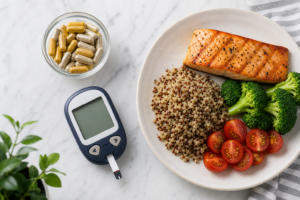
- Broccoli: ~11 mcg per ½ cup (one of the richest plant sources)
- Grape juice: ~8 mcg per cup
- Whole wheat bread: ~4 mcg per slice
- Beef: ~2 mcg per 3 oz
- Orange juice: ~2 mcg per cup
Dietary chromium intake in Western diets averages 20–30 mcg/day — far below the doses used in clinical trials for blood sugar benefits. Refined carbohydrates and processed foods contain minimal chromium and may also accelerate chromium loss through urinary excretion.
Who benefits most
The people with the strongest case for chromium picolinate supplementation:
- Adults with type 2 diabetes not at HbA1c goal: Chromium may modestly lower HbA1c as an adjunct to lifestyle and medication — under physician supervision.
- Adults with prediabetes and insulin resistance: The insulin-sensitizing mechanism is most relevant here; supplements alongside diet and exercise have plausible utility.
- Adults with metabolic syndrome: Multiple components (blood sugar, lipids, weight) may benefit modestly.
- People with dietary chromium deficiency — common in heavily processed-food diets.
People with normal blood sugar and no metabolic dysfunction are unlikely to see meaningful benefit, as chromium's effect is most pronounced when insulin signaling is impaired. For lifestyle-first strategies before adding supplements, see how to support healthy blood sugar after meals. For a supplement with stronger and more replicated blood sugar evidence, see berberine for blood sugar.
Side effects and safety
Chromium picolinate is considered safe at supplemental doses in healthy adults:
- No significant adverse effects in clinical trials at doses up to 1,000 mcg/day
- The FDA has granted GRAS (generally recognized as safe) status for chromium picolinate in certain applications
- No evidence of organ toxicity at typical supplemental doses
Some rare concerns:
- Blood sugar lowering: At higher doses, chromium may lower blood sugar significantly — especially when combined with diabetes medication. Monitor glucose if you are on metformin, sulfonylureas, or insulin.
- Kidney and liver: Case reports (rare) of kidney and liver damage associated with very high chromium picolinate intake (5,000–10,000+ mcg/day — far above supplemental doses). Not observed at typical supplement doses.
- Potential mutagenicity concern: Laboratory studies raised theoretical concerns about chromium picolinate's genotoxicity at very high concentrations. This has not been observed in human clinical trials at supplemental doses.
Tolerable upper intake level: The Institute of Medicine has not established a formal upper limit for chromium, as no adverse effects have been established at typical supplemental doses.
Drug interactions:
- Insulin and diabetes medications: Additive blood sugar lowering — monitor closely and discuss with your prescriber
- NSAIDs and antacids: May affect chromium absorption
- Thyroid medications: Chromium may interfere with levothyroxine absorption if taken simultaneously — separate by at least 3–4 hours
What chromium picolinate is not
Chromium is not a diabetes treatment. It does not replace medication, and its effect size (typically 10–20 mg/dL fasting glucose reduction) is modest compared to metformin or lifestyle intervention. People with type 2 diabetes should use it as an adjunct under physician guidance, not as a self-prescribed replacement for medication.
It also does not reliably cause significant weight loss on its own. Marketing claims about chromium picolinate as a "fat burner" are overstated relative to the evidence.
Frequently Asked Questions
Does chromium picolinate actually lower blood sugar?
What is the best dose of chromium picolinate for blood sugar?
Can chromium picolinate cause low blood sugar (hypoglycemia)?
What is the difference between chromium picolinate and chromium polynicotinate?
How long does chromium picolinate take to work?
Is chromium picolinate safe for long-term use?
Should I take chromium picolinate if I don't have blood sugar problems?
Does chromium help with sugar cravings?
Bottom line
Chromium picolinate has modest but real clinical evidence for improving insulin sensitivity, fasting blood sugar, and HbA1c in people with type 2 diabetes or insulin resistance. The effect is not large enough to substitute for medication or meaningful lifestyle changes, but it is a plausible adjunct for people with metabolic dysfunction at 600–1,000 mcg/day. Chromium picolinate is the best-evidenced form. For people with normal blood sugar, supplementation is unlikely to be worthwhile.
Related Articles
- Berberine for Blood Sugar: What the Research Shows
- Berberine vs Metformin: What the Research Actually Compares
- How to Support Healthy Blood Sugar After Meals
Sources
- Diabetes 1997: Anderson et al. — chromium picolinate and type 2 diabetes — https://pubmed.ncbi.nlm.nih.gov/9356027/
- Journal of Clinical Pharmacy and Therapeutics 2014: Chromium meta-analysis — https://pubmed.ncbi.nlm.nih.gov/24841545/
- Diabetes Care 2006: Chromium picolinate and insulin resistance — https://pubmed.ncbi.nlm.nih.gov/16873778/
- Cochrane Database 2015: Chromium for type 2 diabetes — https://pubmed.ncbi.nlm.nih.gov/24845724/
- NIH Office of Dietary Supplements: Chromium — https://ods.od.nih.gov/factsheets/Chromium-HealthProfessional/