
Disclosure: This article may contain affiliate links. If you buy through these links, we may earn a commission at no extra cost to you. Our recommendations are based on editorial criteria, not commission rates.
———————————————– | —————————— | ——————————- |
| KSM-66 (root extract, 5% withanolides) | 300 mg twice daily | 600 mg/day |
|---|---|---|
| Sensoril (root and leaf extract, 10% withanolides) | 125–250 mg once or twice daily | 125–500 mg/day |
| Shoden (concentrated extract, 35% withanolides) | 120–240 mg once daily | 120–240 mg/day |
| Raw root powder | 3,000–5,000 mg/day | Less consistent bioavailability |
The KSM-66 extract (300 mg twice daily = 600 mg/day) is the most replicated dose in the stress and sleep literature. Sensoril uses a different extraction method and a broader withanolide spectrum (including leaf withanolides), with slightly lower mass doses but potentially comparable effect.
What form to choose
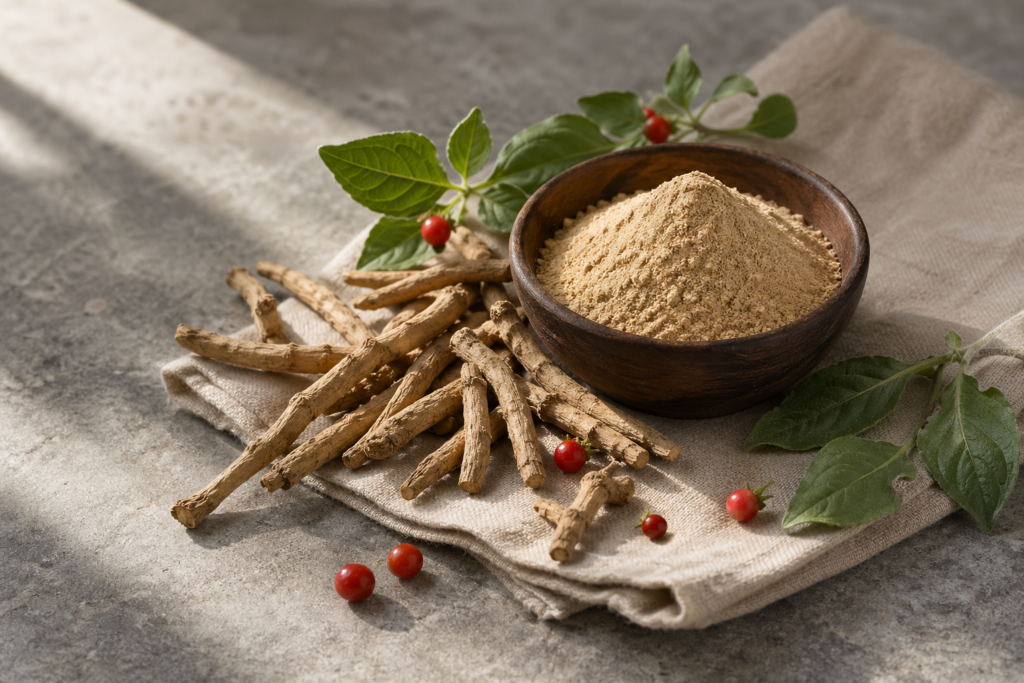
Standardized extracts are significantly more reliable than raw root powder because withanolide content in raw powder varies by soil, growing conditions, harvest time, and storage.
- KSM-66: The most studied extract for stress, sleep, and physical performance. Uses only root material. Extensively published.
- Sensoril: Also well-studied; uses root and leaf material. Slightly lower typical dose.
- Shoden: Newer, higher withanolide concentration (35%), fewer but promising trials.
- Raw root powder: Lower cost but inconsistent potency.
When buying, look for the specific extract name (KSM-66 or Sensoril) on the supplement facts panel rather than just "ashwagandha root extract." Generic extracts without named sources have no way to verify withanolide content.
How long before it works
Most clinical trials report significant effects at 8–12 weeks of consistent daily use. Some people notice reduced stress reactivity and improved sleep quality within 2–4 weeks, but the full cortisol-modulating effect tends to build over time.
Ashwagandha is not a sedative or an anxiolytic drug. It does not produce an immediate relaxing effect the way benzodiazepines or alcohol do. Its benefit accumulates through sustained HPA axis modulation.
Side effects
At doses used in clinical trials, ashwagandha is generally well tolerated. Reported side effects include:
- Mild gastrointestinal upset (nausea, loose stools) — usually resolves with food
- Drowsiness, particularly at higher doses — take in the evening if this occurs
- Rarely: headache, allergic reactions
More serious but rare:
- Liver injury: Case reports of hepatotoxicity (liver damage) associated with ashwagandha supplements have been published. The mechanism is unclear and may relate to product adulteration or idiosyncratic reactions in susceptible individuals. People with liver disease should avoid ashwagandha.
- Thyroid stimulation: Ashwagandha may increase T3 and T4 thyroid hormone levels. For people with hyperthyroidism or on thyroid medication (levothyroxine), this can cause hyperthyroid symptoms.
Who should avoid ashwagandha
- Pregnant women: Ashwagandha has traditionally been used to induce abortion in some Ayurvedic applications. Its safety in pregnancy is not established.
- Thyroid disease: May raise thyroid hormone levels; check with your endocrinologist or prescriber if you have hypothyroidism or hyperthyroidism.
- Autoimmune conditions: Ashwagandha stimulates immune function. People with autoimmune conditions (lupus, multiple sclerosis, rheumatoid arthritis) or taking immunosuppressants should consult their physician.
- Nightshade sensitivity: Ashwagandha is a member of the Solanaceae (nightshade) family. People with nightshade allergies may react.
- Surgery: Ashwagandha may affect anesthesia. Stop at least 2 weeks before scheduled surgery.
- Sedative medications: Ashwagandha has mild sedative properties. Combining with prescription sedatives, sleep medications, or alcohol may cause additive sedation.
Practical use guidance
For stress reduction: 300 mg KSM-66 or 250 mg Sensoril taken in the morning or split morning/evening. Consistent daily use for at least 8 weeks to assess benefit.
For sleep improvement: 300 mg KSM-66 or 120–240 mg Shoden taken 30–60 minutes before bed. The mild sedative quality is better used in the evening for this purpose. L-theanine and magnesium glycinate are frequently combined with ashwagandha in sleep stacks for complementary mechanisms.
For exercise performance: 300 mg KSM-66 twice daily around training periods; best studied in combination with a resistance training program.
Frequently Asked Questions
Does ashwagandha actually reduce cortisol?
How long does ashwagandha take to work?
Is KSM-66 the best ashwagandha?
Can ashwagandha help with anxiety?
Does ashwagandha affect hormones?
Can I take ashwagandha every day?
Is ashwagandha safe with antidepressants?
Does ashwagandha cause weight gain or weight loss?
Bottom line
Ashwagandha has more randomized controlled trial support than most herbal supplements. The KSM-66 and Sensoril extracts at evidence-based doses (300–600 mg/day) consistently show meaningful reductions in cortisol, stress perception, and sleep onset time over 8–12 weeks. The main cautions are thyroid disease, pregnancy, autoimmune conditions, and the recently documented (though rare) liver injury risk — which makes buying from brands that use named, quality-tested extracts more important than price comparison. For people managing chronic stress or poor sleep with an otherwise healthy profile, ashwagandha is one of the most credible supplements to consider.
Related Articles
- L-Theanine for Anxiety and Sleep: Benefits, Dosage, and Safety
- Magnesium for Sleep: Benefits, Forms, and Safety
- Best Time to Take Magnesium: Morning, Evening, or With Food?
Sources
- Indian Journal of Psychological Medicine 2012: KSM-66 and cortisol — https://pubmed.ncbi.nlm.nih.gov/23439798/
- PLOS ONE 2019: Ashwagandha and sleep quality — https://pubmed.ncbi.nlm.nih.gov/31728244/
- PLOS ONE 2021: Ashwagandha sleep meta-analysis — https://pubmed.ncbi.nlm.nih.gov/34340404/
- Medicine (Baltimore) 2019: Shoden extract and cortisol — https://pubmed.ncbi.nlm.nih.gov/31517876/
- Journal of the International Society of Sports Nutrition 2015: Ashwagandha and strength — https://pubmed.ncbi.nlm.nih.gov/26609282/
- NIH National Center for Complementary and Integrative Health: Ashwagandha — https://www.nccih.nih.gov/health/ashwagandha